

How to Go From Executive Assistant to Chief of Staff: The Move Nobody Promotes You Into
Being a better EA won't make you a Chief of Staff. The move runs on a different kind of authority, and you can start earning it before the title changes.
How to Hire a COO: The Job Description Founders Write, and the One They Should
Most COO job descriptions describe a very senior project manager. Here's the one that describes an owner, and the five questions that find one.
Chief of Staff vs. Executive Assistant vs. Operations Manager: Three Jobs Founders Keep Hiring Into the Same Seat
Hire an EA and expect a Chief of Staff, and you'll be disappointed. Hire a Chief of Staff and use them as an EA, and they'll be gone in a year. The difference isn't seniority.

Do You Need a COO Yet? What Breaks at 20, 50, and 80 People
Founders ask “do we need a COO?” at the wrong moment — usually after something broke. Here’s what breaks at 20, 50, and 80 people, and which of it means yes.

Fractional COO vs. Full-Time COO: When Renting Stops Making Sense
The question isn’t whether you can afford a full-time COO. It’s whether you have a full-time COO’s worth of decisions yet. Four questions that tell you.

Chief of Staff vs. COO: Which One Does Your Company Actually Need?
Founders describe one role and name the other. The difference isn’t seniority or scope — it’s where the authority sits. Four questions that settle it.

Fractional Was the On-Ramp. Full-Time Is the Destination.
Why the operator role keeps getting rented — and why the smartest founders eventually buy.
The fractional operations wave was one of the healthiest things to happen to growing companies in years. It let founders who couldn't yet justify a full executive hire get real operational leadership on a schedule they could afford. It worked. I've done it, and I've watched it change how companies run.
But I want to say something that cuts against my own business model: for a lot of companies, fractional was never the destination. It was the on-ramp — the thing that finally showed them the role was load-bearing.
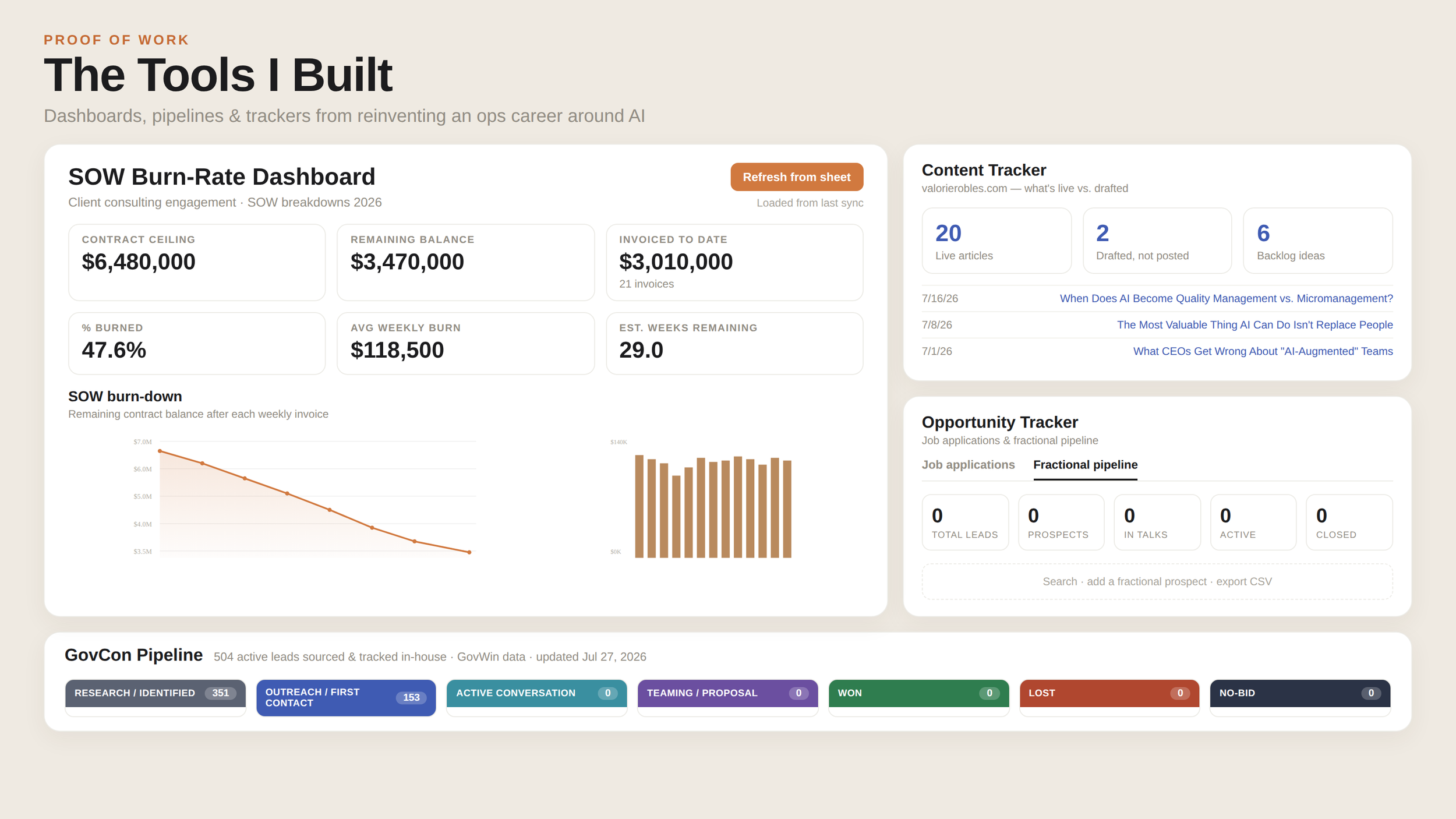
I Watched AI Come for My Job — So I Learned to Wield It
A field report from the messy, exhilarating middle of reinventing an operations career around AI.
There's a specific kind of quiet that settles over you when you realize the tools being built across your industry could do your job. Not help you do it better. Do it instead of you.
I felt that quiet a while back. I work in tech, in operations — the connective tissue that keeps a company actually running. And I watched the market lean toward tools that weren't really designed to make operational people faster or sharper, but to make them optional. When you spend your days close to how these tools get built, you start to notice the assumption baked into a lot of them: that the work of operations is mostly automatable. Sitting with that trajectory is a strange thing.
I could have spent that season being anxious about it, and some days I was. But somewhere in there I made a different decision, and it's the decision this whole article is really about: I decided I would rather out-learn the shift than wait to see where it left me.

What I Actually Do in My First 90 Days
Most executives spend their first 90 days listening. I spend mine fixing.
That’s not a brag. It’s a structural reality. When a founder brings in a fractional COO or Chief of Staff, they’re not hiring someone to observe. They’re hiring someone because something — often several things — has quietly broken, and the company is scaling faster than its operating system can handle.
The “listen first” advice exists for a reason: premature action based on incomplete information is a real failure mode. But there’s another failure mode nobody talks about. It’s the executive who spends 90 days in discovery while the team keeps bleeding, the process debt keeps compounding, and the founder keeps wondering when they’re going to see a return on the hire.
Here’s what I actually do.

Good Process Is Invisible
Say the word "process" in the wrong room and watch what happens.
Screens don't go down. Eyes don't light up. What you get instead is a specific kind of stillness — the kind that means everyone in the room just added something to their mental list of things they're going to have to tolerate.
That reaction is data. Not about process. About what people believe process is.
They believe it's a rulebook. A stack of requirements. A manager's way of adding friction to work that was flowing just fine. They think of process as the ten-page document that nobody reads, the approval chain that slows everything down, the form that has to be filled out before anything can move.

Operations Isn’t the Back Office. It’s the Growth Strategy.
There’s a moment every growing company hits. Revenue is climbing, the team is expanding, and the CEO is busier than ever — yet somehow everything feels harder. Decisions stall. Hiring is reactive. Compliance is a someday problem. The founder is in every meeting because nothing moves without them.