

Please Stop Putting AI in Everything (From a Pro-AI Operator)
I'm a giant believer in AI for operations. That's precisely why forced, bolted-on AI drives me up the wall. If a task takes thirty seconds and works, making it twenty-nine isn't efficiency — it's theater.

You Don't Have an AI Problem. You Have a Governance Gap.
Everyone deployed AI agents. Most companies can't govern them. Governance isn't a model setting — it's decision rights, escalation paths, and accountability. In other words, operations.
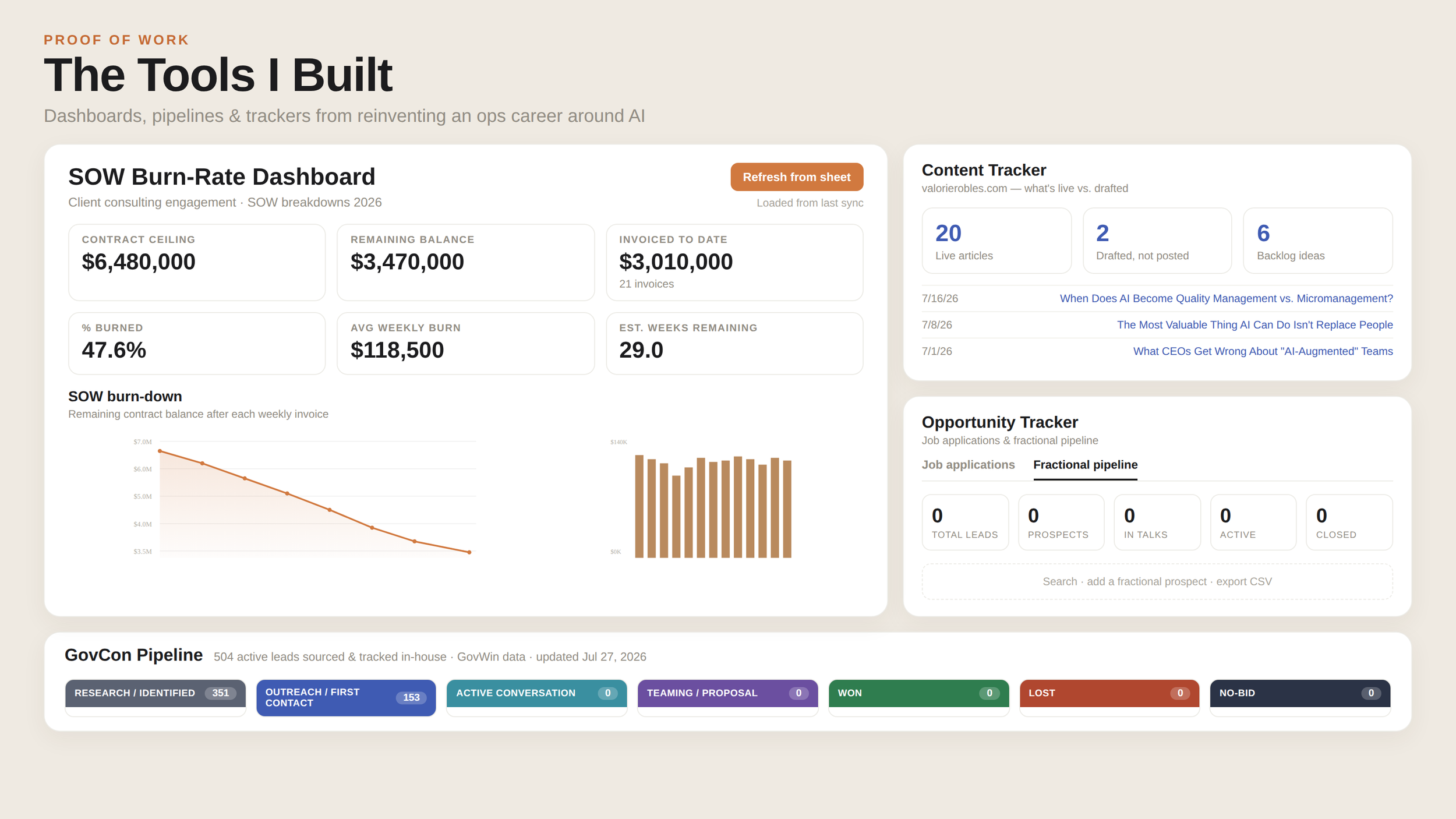
I Watched AI Come for My Job — So I Learned to Wield It
A field report from the messy, exhilarating middle of reinventing an operations career around AI.
There's a specific kind of quiet that settles over you when you realize the tools being built across your industry could do your job. Not help you do it better. Do it instead of you.
I felt that quiet a while back. I work in tech, in operations — the connective tissue that keeps a company actually running. And I watched the market lean toward tools that weren't really designed to make operational people faster or sharper, but to make them optional. When you spend your days close to how these tools get built, you start to notice the assumption baked into a lot of them: that the work of operations is mostly automatable. Sitting with that trajectory is a strange thing.
I could have spent that season being anxious about it, and some days I was. But somewhere in there I made a different decision, and it's the decision this whole article is really about: I decided I would rather out-learn the shift than wait to see where it left me.

What CEOs Get Wrong About "AI-Augmented" Teams
Every week I hear some version of the same conversation.
A CEO has decided the company is going “AI-first.” They’ve purchased a suite of tools. They’ve announced it in an all-hands. They’re expecting efficiency gains within the quarter.
Six months later, they’re frustrated. Adoption is patchy. Half the team is using the tools, half isn’t. The efficiency gains haven’t materialized. And somewhere in a Slack channel nobody checks, there are three different AI workflows doing three versions of the same thing, none of them talking to each other.
This is not an AI problem. It’s an operational design problem. And it stems from a handful of mistakes I see CEOs make almost every time.

AI in Service of Culture: The Communication Problem Most Leaders Get Wrong
The first piece made the operational case for structure inside a flat organization. The second piece argued that structure only works when leadership has the trust to let go. The third piece showed the ROI — that healthy culture, built on clear structure and real trust, outperforms the S&P 500 by roughly 2,000% in cumulative returns over time.
This last piece is about the question every leader I work with eventually asks: where does AI fit into all of this?
The short answer is that AI belongs in service of culture, not in place of it. It’s a supporting role, not a replacement. And the reason most companies get the AI rollout wrong has very little to do with the technology — and almost everything to do with how leadership communicates it.